
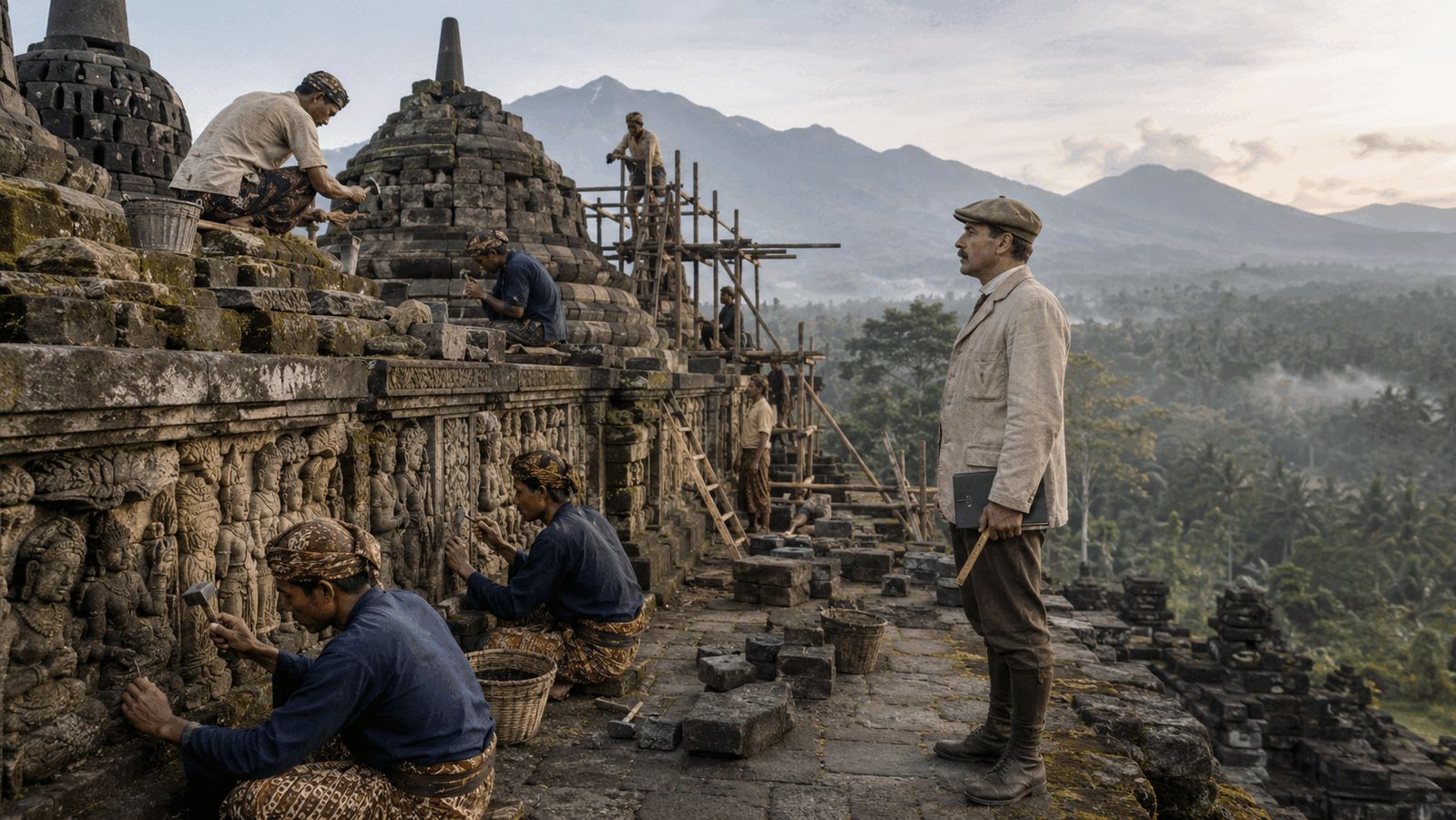
The Theodoor Van Erp Borobudur story is an important chapter in the preservation history of Indonesia’s greatest Buddhist monument. As an early conservation specialist, Theodoor Van Erp played a major role in protecting Borobudur during the beginning of modern restoration efforts.
His work helped save the temple from further deterioration. The restoration methods he developed also became an important foundation for future conservation programs.
The Condition of Borobudur Before Van Erp’s Restoration
After its rediscovery in the 19th century, Borobudur attracted attention from historians and researchers. However, the monument faced serious preservation problems.
The structure suffered from weather damage, unstable stones, and poor drainage systems. Many parts of the temple were affected by water exposure and environmental conditions.
Early preservation attempts were not enough to solve the complex problems. Experts needed a more organized restoration approach to protect the monument.
Visitors can learn more about this historical journey through Borobudur Temple history, origins, rediscovery, restoration, and legacy.
The Role of Theodoor Van Erp
Theodoor Van Erp was a Dutch military engineer who became closely associated with Borobudur’s first major restoration project. Between 1907 and 1911, he led a significant conservation effort to stabilize and improve the condition of the temple.
Van Erp carefully studied Borobudur before starting restoration work. He documented damaged areas and examined the original structure to understand how the monument was built.
His approach focused on preserving the temple’s historical character. Instead of making major changes, he attempted to maintain the original design and architectural elements.
Van Erp’s Restoration Methods
During the restoration period, Van Erp and his team worked on several important sections of Borobudur. They removed accumulated materials, repaired damaged stones, and improved parts of the structure.
One of his major contributions involved correcting drainage problems. Water had caused serious damage to the temple walls and foundations.
Van Erp also reconstructed several architectural elements. His careful documentation helped future researchers understand the original appearance of Borobudur.
Although some restoration decisions were later reconsidered, his work provided valuable knowledge for modern conservation practices.
The Impact of Van Erp’s Work
The restoration led by Theodoor Van Erp changed the future of Borobudur. His efforts prevented further damage and increased awareness of the monument’s importance.
His documentation became an important reference for later restoration projects. Conservation experts used these records when planning larger preservation programs in the 20th century.
The work also demonstrated the importance of scientific approaches in protecting cultural heritage sites.
Borobudur’s Later Conservation
After Van Erp’s restoration, Borobudur continued to face preservation challenges. Environmental conditions and structural problems required ongoing attention.
The Indonesian government later collaborated with UNESCO for a major restoration project between 1975 and 1982. This program strengthened the monument and protected its historical features.
Today, Borobudur remains carefully preserved as a UNESCO World Heritage Site. Conservation teams continue monitoring the temple to maintain its condition.
Travelers who want to explore this remarkable heritage site can join a Borobudur Temple tour to discover its architecture and restoration history.
Conclusion
The Theodoor Van Erp Borobudur connection represents a significant moment in the history of temple preservation. His early restoration work helped protect Borobudur and created valuable knowledge for future conservation efforts.
Understanding Van Erp’s contribution allows visitors to appreciate the dedication behind preserving this ancient masterpiece. Borobudur’s survival today reflects the combined efforts of many generations of researchers and conservation experts.
